
Le Palace, quite a story…
The building that houses Le Palace cinema is a true jewel of Brussels’ heritage. More than a century went by before it returned to its original purpose: as the home of an entertainment complex. Today, the building retains the spirit and stylistic hallmarks of Art Nouveau. Let’s take a closer look at a remarkable history.
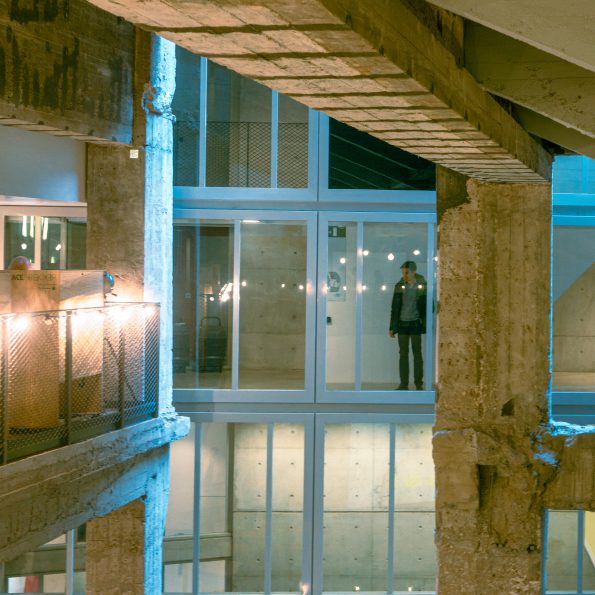
If you would like more information about the renovation of the venue, here is the vision of Alain Richard, whose architectural studio was commissioned to renovate Le Palace.
1881
Designed by Albert Dumont, the Hôtel des Ventes de la Ville de Bruxelles was built on a Y-shaped plot of land that would later house the Pathé Palace. It featured an ornate main façade, on Boulevard Anspach, and two more restrained façades, on Rue Van Praet and Rue Borgval.
1913
A pioneer in film distribution, Charles Pathé commissioned Paul Hamesse to build a multi-purpose entertainment complex modelled on Italian-style theatres. A disciple of Paul Hankar, the architect designed “the largest cinema in the city” (2,500 seats), long remembered in Brussels society for the opulence of its décor.
1926
Pathé Frères wanted to convert the “Grand Palais d’Attractions” into a modern cinema. Architect Gustave Hubrecht transformed the ground floor of the main screen: a section of the stalls was raised to optimise the audience’s view and the Moorish café was divided into partitioned boxes.
1929
With the arrival of talking pictures, speakers were added behind the screens. The pits that housed the orchestra during the silent era were replaced by rows of extra seats, and the walls of the screening rooms were covered with materials designed to improve acoustics.
1950
Pathé Frères commissioned architect Rie Haan to modernise Le Palace’s Italian-style screening rooms. Most of the original decorative elements were removed, making way for more fluid passageways. Only a few vestiges from 1913 remained, hidden from view, including the Hamesse Foyer.
1952
As part of another project, Rie Haan converted part of the site into shops and accommodation on behalf of Het Brussels Tehuis.
1973
The cinema closed. The installation of a Bauknecht showroom in the vestibule of the Anspach wing in 1976 dealt a severe blow to the venue’s image. A mezzanine floor was added, resulting in the removal of the lower double flights of stairs. Parking spaces were created in place of the main screen’s stalls, and the ground floor of the Anspach façade was clad in metal.
1994
The Pathé Palace Café (PP Café) opened its doors on the ground floor of the rue Van Praet. The decoration of the bistro clearly drew on Paul Hamesse’s style: the columns were decorated with copies of the gilded heads of the Anspach foyer, the walls and ceilings featured faithfully reproduced mouldings and pictorial decorations, and the banquettes from the same foyer were salvaged and recycled.
1997
The three façades and the Hamesse Foyer were listed by the Commission royale des Monuments et Sites.
1998
After 41 years of being used for different things, the building was finally going to be returned to its original purpose thanks to the Kladaradatsch project! The large 1950s screening room was divided into three sections. The remaining traces of the 1913 ceiling were removed to make way for a new coffered structure, providing improved acoustics and greater fire safety. Architect Joël Claisse faithfully restored the Hamesse Foyer and its gallery.
2001
The French Community bought the building. Architect Olivier Bastin installed a specially adapted stage, allowing the Théâtre National de Belgique to set up home there until the end of 2004, pending the inauguration of its new site on Boulevard Emile Jacqmain.
2003
The French Community issued a call for expressions of interest to convert the site into an art house cinema “showcasing films from the French Community of Belgium and European cinema more broadly”.
2004
It was non-profit organisation Le Palace that won the call for projects, supported by a number of major players from the Belgian film world: Luc and Jean-Pierre Dardenne (Les Films du Fleuve), Patrick Quinet (Artémis Productions), Eliane Du Bois and Stephan De Potter (Cinéart-Cinélibre), Nicole La Bouverie (Zénab). The programme included Belgian and European art house cinema, educational activities and major events.
2006
The French Community approved the agreement granting free use of the building, along with the programme agreement committing the non-profit Le Palace to promoting access to culture for all. The Alain Richard architectural studio was chosen to carry out this ambitious refurbishment. The one guiding principle was integration. Given the complexity of the project, the start of construction was not scheduled before mid-2009.
2012
The building’s successive alterations and uses resulted in a series of fragmented spaces. To restore the coherence that this iconic site deserved, Alain Richard chose to “create emptiness” around the existing elements and introduce natural light into the heart of the complex. His challenge came to fruition in November 2012 when work began.
2018
After five years of renovation, Le Palace cinema had been given a facelift. Four state-of-the-art screens, a restaurant and a host of multicultural spaces were unveiled to the public, revealing their identity as an entertainment complex built around discovery, education and openness.